

Cybercrime
,
Fraud Management & Cybercrime
UN Says Southeast Asian Scam Centers Generate $41 Billion in Illicit Annual Profits
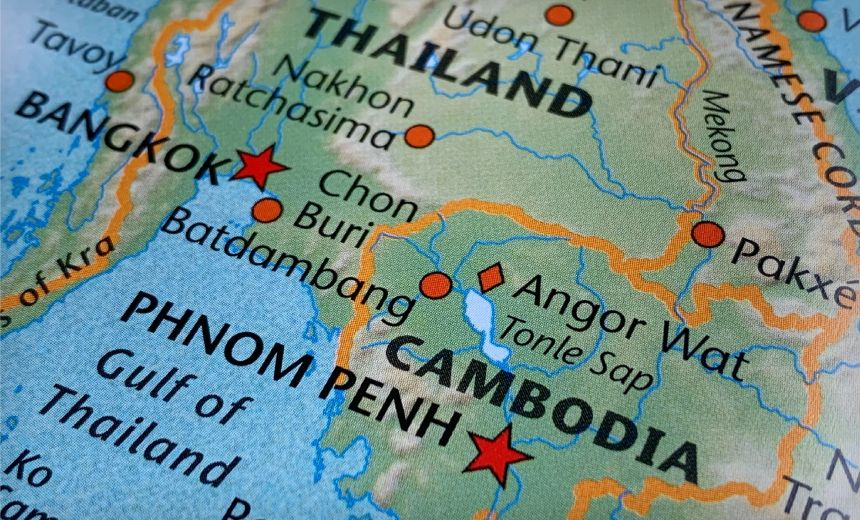
Thailand is recasting a flaring conflict with neighboring Cambodia as a fight over cybercriminal compounds spread alongside the two Southeast Asian nations’ contested border.
See Also: Why Cyberattackers Love ‘Living Off the Land’
Fighting including artillery and air strikes resumed earlier this month after a lull in fighting that broke out in July, sparked by long-standing territorial disputes. Thailand now says air strikes this month against Cambodian casino and hotel complexes are part of a “war against the scam army.”
No peace will be possible, caretaker Thai Prime Minister Anutin Charnvirakul told reporters Wednesday at an international anti-scam conference in Bangkok, until Cambodia’s Phnom Penh-based government moves decisively to “destroy scamming attempts,” reported AFP. Anutin earlier rejected calls for a ceasefire, writing in a social media post hours after U.S. President Donald Trump claimed to have brokered a truce that his country would “continue to perform military actions until we feel no more harm and threats to our land and people.”
Transnational criminal groups raking in tens of millions per day from online scams operate in compounds located throughout Cambodia and Southeast Asia, including a cluster in the Cambodian casino hub and border city of Poipet. Thailand on Thursday used F-16s to target Poipet in an attack a spokesperson said targeted a rocket launcher depot.
“The attacks were not solely focused on casinos and scammers,” a Royal Thai Army spokesman said, when asked by reporters about whether the Poipet strike targeted scammers, reported Bloomberg. “Every target identified was clearly being used as a military base, frequently including drone command centers and weapons depots.”
The Thai military earlier bombed the O-Smach Resort, a casino and hotel located near a small town close to the two countries’ border, reported the Wall Street Journal. The U.S. Department of Treasury sanctioned in September 2024 the resort and its owner for operating a forced labor scam compound. The military also targeted a compound located in the Pursat Province of Cambodia that came under U.S. sanctions in September for operating a virtual currency scam compound.
Transnational online criminals operating on an industrial scale have embedded deeply into Cambodia’s ruling elite, the U.S. Institute for Peace found in May 2024. Their operations include romance and investment scams such as pig butchering, in which a victim is tricked into transferring higher and higher amounts of money, until their funds run out, as well as illegal online gambling.
The U.N. Office on Drugs and Crime estimates that Southeast Asian scam centers generate $41 billion in annual profits. The centers, which exist not only in Cambodia but also Laos, Malaysia, Myanmar and the Philippines, have “reached the level of a humanitarian and human rights crisis,” said experts who advise the U.N.’s Human Rights Council.
The U.N. Human Rights Office estimates that hundreds of thousands of individuals are trapped at scam centers, including at least 100,000 victims across 300 such centers in Cambodia alone. Experts say that in many cases, the centers appear to be run by Chinese cybercrime syndicates (see: Cambodian Conglomerate a ‘Pig Butchering’ Outfit, Says US).
“Southeast Asia is the ground zero for the global scamming industry,” said Benedikt Hofmann, a UNDOC regional representative. To staff the scam centers, recruiting agents typically use email or social media channels – including Facebook and WhatsApp – to lure job seekers with fake offers of work, including well-paying telemarketing and IT positions.
After arriving, victims learn they’ve been lured by a crime ring and get threatened with torture unless they help perpetrate voice phishing and other scams. Victims have described being forced to work 17-hour days, handcuffed by their ankles or to their bed – when they were working or not working, respectively – unless they met “sales quotas,” being beaten with iron pipes and subjected to electric shocks, in some cases by North Koreans, and threatened with further violence if they agitate or attempt to flee. The scam centers make money not only from fraud victims but also through ransoms paid by the families of trafficked individuals.
Beefs and Complicity
Relations between Thailand and Cambodia are particularly fraught at the moment, not least because Cambodia appeared to engineer the ousting of Thai Prime Minister Paetongtarn Shinawatra. Cambodian Senate president Hun Sen in June leaked a phone call in which Paetongtarn appeared critical of the Thai military. Public outrage ensued, leading to her being suspended by the constitutional court in July for ethical violations, and removed from office in August.
Thailand’s parliament in early September selected business tycoon Anutin to serve as caretaker prime minister, the third person to occupy that office in two years. Subsequent efforts by Trump and Malaysian Prime Minister Anwar Ibrahim to reinstate the ceasefire have been rebuffed. “We don’t have to listen to anyone,” Anutin said, according to the BBC.
The border conflict has included artillery exchanges, wildly inaccurate rocket attacks by Cambodia and the Thai air force using its jets to bomb targets inside Cambodia, according to multiple media reports.
Washington has urged the nations to find a diplomatic solution. On Thursday, U.S. Secretary of State Marco Rubio called on Thai Foreign Minister Sihasak Phuangketkeow to take “concrete actions” to deescalate the conflict.
Cambodia government has rebuffed criticism that it’s not doing enough to disrupt scammers, saying it “remains firmly committed to preventing and suppressing all forms of cross-border crimes, particularly online scams.”
The U.S. Department of State said in a trafficking report published this year that “government officials financially benefit from human trafficking,” including in the form of “senior-officials-owned properties used by online scam operators to exploit victims in forced labor and forced criminality.” Human rights experts say the scam operations are flourishing thanks to active support from Cambodian government officials.
Amnesty International in June accused the Cambodian government of “deliberately ignoring a litany of human rights abuses including slavery, human trafficking, child labor and torture” committed by criminal gangs operating from over “50 scamming compounds located across the country.”
Criticism of the government has been intensifying since this summer, when a 22-year South Korean student who was lured to the country by an apparent scam ring was tortured to death. Three Chinese nationals have been arrested and charged with murder and online fraud. Two additional suspects remain at large.
South Korea has warned citizens about a rise in kidnappings and issued travel warnings advising against visiting parts of Cambodia.
With reporting by Information Security Media Group’s David Perera in Northern Virginia.