

Advanced SOC Operations / CSOC
,
Artificial Intelligence & Machine Learning
,
Next-Generation Technologies & Secure Development
Funding at $1.2B Valuation to Propel Federal Market Entry and R&D in GenAI
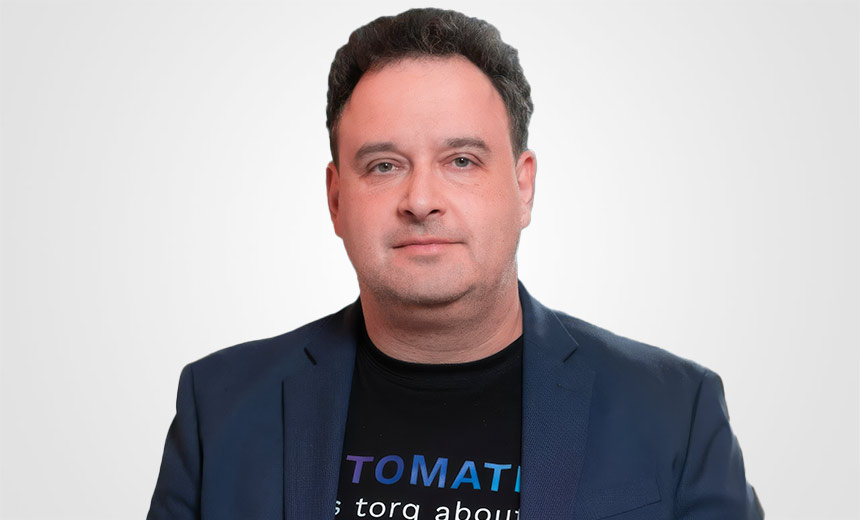
A hyper automation startup founded by the former CEO of Luminate Security raised $140 million to address growing enterprise adoption of artificial intelligence in security operations.
See Also: The Comprehensive Guide to Cloud Security and SOC Convergence
The Merlin Ventures-led Series D funding round will fuel New York-based Torq’s expansion into federal and international markets, deepen investment in AI-based cybersecurity capabilities and accelerate R&D, said co-founder and CTO Leonid Belkind. The money will aid AI research and engineering, including deeper threat hunting capabilities powered by small, customer-specific AI models, he said.
“We are seeing Fortune 500 companies adopting our AI technologies – really adopting – not to play with it – in production, showing their management the impact it makes on their KPIs and so on,” Belkind told Information Security Media Group. “And we feel that this is the time to floor the pedal.”
Torq, founded in 2020, employs 372 people and has raised $332 million in six rounds of outside funding, having last received a $70 million Series C investment in September 2024 led by Evolution Equity. The company has been led since its inception by Ofer Smadari, who previously started and led browser security startup Luminate Security before selling it to Symantec for $139 million in February 2019 (see: Startup Torq Secures $70M to Advance Hyperautomation With AI).
Why AI Is a Core Design Principle for Torq
Torq aims to penetrate the highly regulated federal cybersecurity space where AI-based operations are not only in demand but critical for handling massive, government-mandated data volumes, Belkind said. In parallel, Torq is pursuing global commercial expansion in heavily regulated geographies including Canada, Brazil and Australia where localized and compliant services give them a competitive edge.
“We look at accelerating on a number of fronts,” Belkind said. “We look at going big time after the federal SOC modernization market. Another one is that commercially expanding to Asia-Pacific last year has been tremendous. We literally over-delivered on our ambitious goals there. In order to sustain all that, we also need to double down more on our innovation, AI research, AI engineering.”
Belkind said AI is a core design principle guiding how detection, triage, response and automation are implemented across customer environments. The platform’s ability to act autonomously rather than just suggest actions is key to delivering on the promises of operational speed, precision and cost reduction, according to Belkind.
“AI is not a small feature decoration here and there. It’s becoming a core technology, maybe even a core set of technologies,” Belkind said. “We are building out fully defensible, unique capabilities based on collaboration with Fortune 500 companies that are happy to collaborate with us, share data, learn together, how it can improve outcomes and so on.”
Off-the-shelf models from OpenAI, Anthropic and others are powerful, but they hit a glass ceiling when it comes to highly accurate, domain-specific outcomes, Belkind said. He said Torq’s research team is building custom small models trained on data sets specific to individual enterprise settings. AI can pursue multiple threat hunting hypotheses in parallel, dynamically deepening its data engagement.
“A team of our AI engineers participated and won in a governmental-sponsored hackathon that delivered real, declassified data with threats,” Belkind said. “So the accuracy that our team managed to demonstrate versus computational cost and time was exceptional. That just shows that the directions that we’re delivering are real.”
Why Torq Sees an Opportunity Selling to the US Government
Recent federal directives have mandated the collection of more extensive logging data across agencies, meaning agencies are now storing large volumes of security data but lack the AI-driven tooling to operationalize it. He said this gap is where Torq aims to deliver value by transforming stored logs into actionable security outcomes via automation and AI.
“Many governmental institutions have accumulated amounts of events data that is on an order of magnitude, if not two, different from what they used to deal with, but have an absence of operational pipeline and tools that can even scale to that amount of information,” Belkind said. “Sure, they’re aggregating it, but they’re not really looking at it efficiently.”
Merlin Ventures plays a multifaceted role in Torq’s federal expansion by providing capital, go-to-market execution via Merlin Cyber, which already holds federal contracts, and compliance enablement, including assistance with Torq’s FedRAMP certification process. Belkind describes the partnership as deep, with confidence in Torq’s AI platform and its applicability to SLED and federal security operations.
“It’s a joint feeling that what we bring here to the table can be brought to SLED and federal markets and can be adopted there en masse,” Belkind said. “So, that’s the big role Merlin will play. They have another arm, which even helps us further to accelerate our FedRAMP program. So actually, it’s a three-pronged collaboration with different arms of Merlin.”
Many government buyers are hesitant to engage with startups unless they demonstrate financial stability, long-term viability and market traction, Belkind said. Notching a $1.2 billion valuation serves as a credibility signal, showing that Torq is no longer a risky upstart but a platform with the resources and market trust to support mission-critical infrastructure. This level of assurance becomes a differentiator.
“Knowing that the player they are betting on is stable, is big, is growing, is supported by the market is really giving them the confidence to go ahead and partner with us,” Belkind said. “Federal governments, when they choose their technological partners, it’s not for a year, it’s not for two years. These are usually longer term projects.”