

Agentic AI
,
Artificial Intelligence & Machine Learning
,
Litigation
Company Says Limits Triggered Federal Retaliation, Which Violate Free Speech Rights
Anthropic accused the U.S. government of behaving unconstitutionally by retaliating against the artificial intelligence developer for its speech and viewpoints about AI safety.
See Also: How Unstructured Data Chaos Undermines AI Success
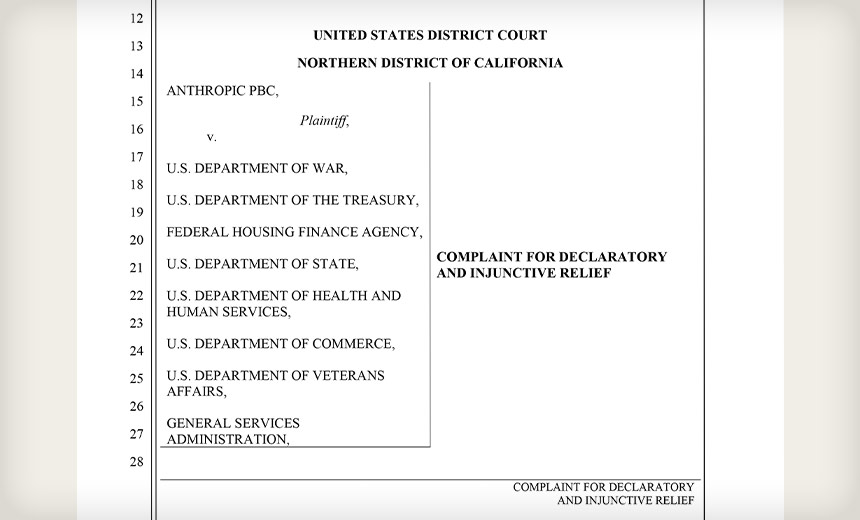
The San Francisco-based company alleged in a 48-page lawsuit Monday that the government punished Anthropic economically after the company argued its AI shouldn’t be used for autonomous lethal warfare or mass surveillance of Americans. The government’s decision to effectively ban Anthropic from federal government use and contracting violates constitutional and statutory law, Anthropic argues.
“When Anthropic held fast to its judgment that Claude cannot safely or reliably be used for autonomous lethal warfare and mass surveillance of Americans, the President directed every federal agency to ‘IMMEDIATELY CEASE all use of Anthropic’s technology’ – even though the Department of War had previously agreed to those same conditions,” Anthropic wrote in its complaint.
The Pentagon officially designated Anthropic a “supply-chain risk” Thursday, which prohibits any defense contractors from using the company’s technology in work connected to the U.S. military. The Department of War declined an Information Security Media Group request for comment on Anthropic’s lawsuit, while Anthropic didn’t respond to a request for additional comment (see: Pentagon Moves to Cut Anthropic From Defense AI Work).
Anthropic: Models Aren’t Trained for Autonomous Weapons Use
Anthropic said its models have never been trained or validated for fully autonomous weapons use, and that AI-driven surveillance could amplify errors or misuse at a scale that existing legal frameworks don’t anticipate. But in negotiations over new contracts, Anthropic said the Department of War demanded it remove its usage policy restrictions and instead allow the military to use Claude for “all lawful uses.”
“These usage restrictions are therefore rooted in Anthropic’s unique understanding of Claude’s risks and limitations – including Claude’s capacity to make mistakes and its unprecedented ability to accelerate and automate analysis of massive amounts of data, including data about American citizens,” Anthropic wrote in a complaint filed in U.S. District Court for the Northern District of California.
Anthropic argued that the government’s actions were not simply a procurement decision to use a different vendor but were punitive measures designed to pressure the company into abandoning its principles. By allegedly using the power of federal procurement and national-security designations to punish a company’s expression, Anthropic said the government engaged in viewpoint-based retaliation.
“The Department [of War] met Anthropic’s attempts at compromise with public castigation,” Anthropic wrote. “It labeled Anthropic’s CEO as too ‘ideological’ and a ‘liar’ with a ‘God-complex’ who ‘is OK putting our nation’s safety at risk.’ The Department eventually gave Anthropic a public ultimatum: ‘Get on board’ and accede to the government’s demands by 5:01 p.m. on Feb. 27, 2026, or ‘pay a price.'”
The supply-chain risk designation allows the government to exclude vendors whose products pose risks of sabotage or compromise by adversarial nations, and was never intended to address disagreements with domestic companies over policy positions, Anthropic said. The government has never alleged that Anthropic’s systems are technically insecure, and is instead using it as leverage in a contract dispute.
“The Secretary’s [of War] actions are contrary to Section 3252’s plain text, were issued without observance of the procedures Congress required and are arbitrary, capricious and an abuse of discretion,” Anthropic wrote in the complaint. “Indeed, Anthropic had been one of the government’s most trusted partners until its views clashed with the Department’s.”
Supply Chain-Risk Label Allegedly Violates Due Process
Supply-chain risk designations must be based on evidence a company could enable foreign adversaries to sabotage or compromise national security systems, and Anthropic said there’s no evidence that it has any ties to foreign adversaries or poses such risks. Anthropic said the government violated due process by imposing severe penalties on the firm without any investigation, hearing or opportunity to respond.
“The Presidential Directive requiring every federal agency to immediately cease all use of Anthropic’s technology, and actions taken by other defendants in response to that directive, are outside any authority that Congress has granted the executive,” Anthropic wrote. “And ‘[w]hen an executive acts ultra vires, courts are normally available to reestablish the limits on his authority.'”
When the government bars a company from contracting with it, Anthropic said the company is entitled to notice of the allegations, an opportunity to respond and a formal decision explaining the basis for the exclusion. Instead, Anthropic said it was abruptly labeled a national-security risk without any hearing or investigation and excluded from federal procurement through public announcements and directives.
“Anthropic has weighty property and liberty interests in its reputation, its business relationships, its future business prospects and its advocacy,” Anthropic wrote in its complaint. “The challenged actions arbitrarily deprive Anthropic of those interests without any process, much less due process.”
Being labeled a national security risk meant federal agencies began terminating contracts and directing employees to stop using Claude, and contractors working with the military also began questioning whether they could legally continue doing business with Anthropic. The company claims these developments put hundreds of millions of dollars in contracts and future opportunities at risk.
“Official designation as a ‘Supply-Chain Risk to National Security’ carries profound weight, particularly under a president who has threatened both ‘criminal consequences’ and ‘the Full Power of the Presidency’ to enforce compliance,” Anthropic said. “Anthropic’s contracts with the federal government are already being canceled. Current and future contracts with private parties are also in doubt.”