

Endpoint Security
,
Governance & Risk Management
,
Internet of Things Security
Mirion Medical Says Bugs Are Fixed in New Release of BioDose/NMIS Software
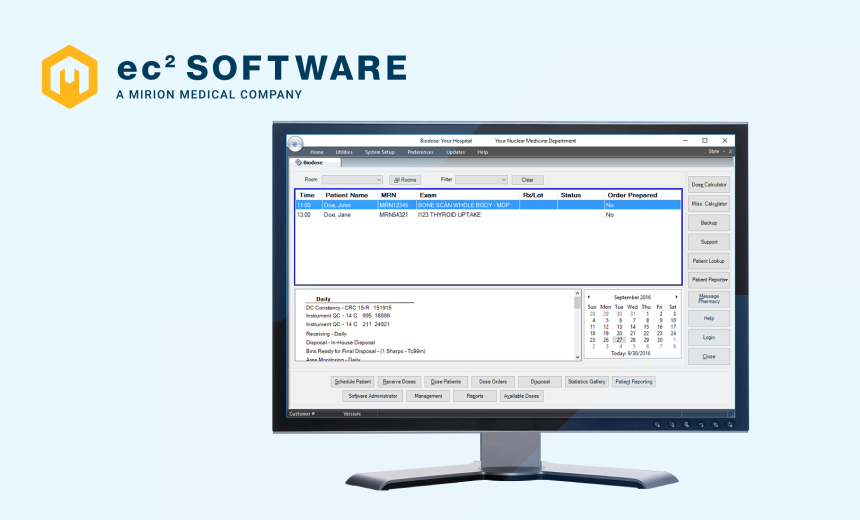
U.S. federal authorities are warning that several high-severity vulnerabilities discovered in Mirion Medical Co. inventory tracking software used by nuclear medicine and radiology departments could allow attackers to modify program executables, remotely execute code and gain access to sensitive information – if exploited.
See Also: Going Beyond the Copilot Pilot – A CISO’s Perspective
The Cybersecurity Infrastructure and Security Agency in an advisory Tuesday said the vulnerabilities, reported to the agency by an independent researcher, affect BioDose/NMIS software versions prior to 23.0, a product of EC2 Software, a company acquired in 2023 by Atlanta-based Mirion Medical.
Mirion Medical, a radiation safety technology company, in a statement to Information Security Media Group, said it has addressed the issues cited in the CISA alert.
“As soon as Mirion became aware of these vulnerabilities we took immediate action to resolve them and provide our customers with fixes at the earliest possible opportunity,” a Mirion spokeswoman said.
“We coordinated with CISA, our customers and other entities according to coordinated vulnerability disclosure process best practices. All fixes are addressed within our latest release of the software, Version 23.”
CISA said the affected Mirion products are used worldwide. Mirion did not immediately respond to ISMG’s inquiry about the estimated number of customers that use the affected BioDose/NMIS software.
The five BioDose/NMIS vulnerabilities flagged by CISA include three “incorrect permission assignment for critical resource” issues, plus one vulnerability involving “use of client-side authentication” and another involving “use of hard-coded credentials.”
Incorrect Permission Assignment Flaws
The incorrect permission assignment for critical resource flaws include CVE-2025-64642, which has a calculated CVSS v3.1 base score of 8.0, and a CVSS v4 score of 7.1.
CISA said that issue relates to directory paths in BioDose/NMIS V22.02 and previous versions that by default have insecure file permissions, “which in certain deployment scenarios can enable users on client workstations to modify the program executables and libraries.”
The second incorrect permission assignment for critical resource vulnerability, CVE-2025-64298, has a calculated CVSS v3.1 base score of 8.4 and a CVSS v4 base score of 8.6.
CISA said the BioDose/NMIS V22.02 and previous version installations in which the embedded Microsoft SQL Server Express is used are exposed in the Windows share accessed by clients in networked environments. “By default, this directory has insecure directory paths that allow access to the SQL Server database and configuration files, which can contain sensitive data,” CISA said.
The third incorrect permission assignment for critical resource vulnerability is assigned as CVE-2025-62575. That flaw has been calculated as having a CVSS v3.1 base score of 8.3 and a CVSS v4 base score of 8.7.
The issue affects BioDose/NMIS V22.02 and previous versions that rely on a Microsoft SQL Server database. “The SQL user account ‘nmdbuser’ and other created accounts by default have the sysadmin role. This can lead to remote code execution through the use of certain built-in stored procedures,” CISA said.
Other Vulnerabilities
The use of a client-side authentication vulnerability identified in BioDose/NMIS version 22.02 is assigned as CVE-2025-61940 and has been calculated to have a CVSS v3.1 base score of 8.3, and a CVSS v4 base score of 8.7.
CISA said the BioDose/NMIS V22.02 and previous versions rely on a common SQL Server user account to access data in the database. “User access in the client application is restricted by a password authentication check in the client software but the underlying database connection always has access,” CISA said. The latest version of BioDose/NMIS “introduces an option to use Windows user authentication with the database, which would restrict this database connection,” the alert adds.
The last vulnerability, assigned CVE-2025-64778, involves use of hard-coded credentials.
CISA said BioDose/NMIS software V22.02 and previous versions contain executable binaries with plain text hard-coded passwords. “These hard-coded passwords could allow unauthorized access to both the application and database.”
This vulnerability has a calcuated CVSS v3.1 base score of 7.3 and a CVSS v4 base score of 8.4.