

Critical Infrastructure Security
,
Endpoint Security
,
Internet of Things Security
Precision Agriculture Boost Yields but Opens Farmers to Cybersecurity Risk
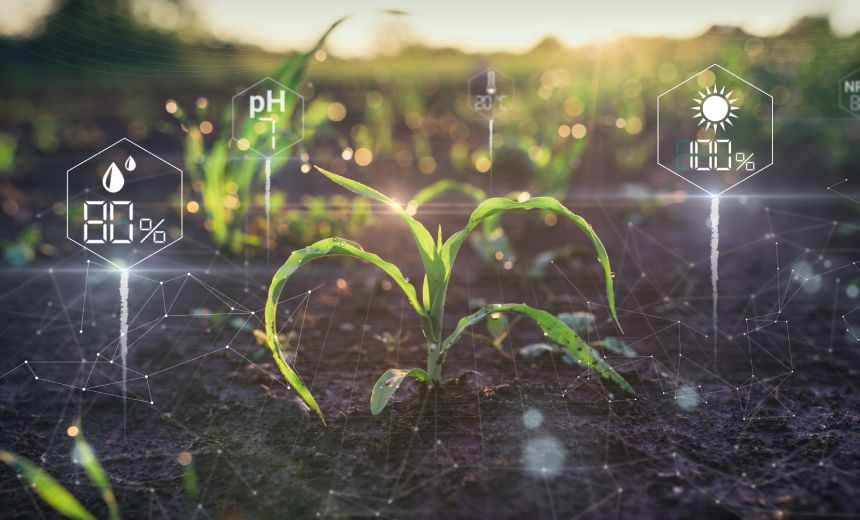
It’s tempting to think of agriculture as the last bastion of an analog world: tractors, animals, rolling fields. But most U.S. farmers are the cutting edge of Internet of Things adoption in a strategy that knits together remote sensors, location data, drone imagery and autonomous machines.
See Also: The Cost of OT Cybersecurity Incidents and How to Reduce Risk
The strategy is known as “precision agriculture.” Backers say that without it, agriculture won’t make the 70% productivity gain it needs to feed the nearly 10 billion people projected by the United Nations to live on Earth by 2050.
With connectivity comes risk, and precision agriculture has triggered a growing number of cyberthreats and incidents resulting in disruptions in food processing, distribution, livestock transportation and crop availability, driving millions of dollars away from small to mid-sized farming operations and into ransomware payments and recovery costs.
Cyberthreats may not be a primary concern at the level of individual farms, but as digital reliance accelerates, productivity increasingly depends on cyber resilience.
“The modern farm is a lot different than it used to be. Obviously, you have this PA technology that continues to innovate. We have sensors, switches, we have automated tractors that are now driving on their own, we’re using drones that monitor specific humidity in the soil,” said Jonathan Braley, director of threat intelligence at the Food and Ag-ISAC.
These innovations are delivering tangible results for small to mid-sized farming operations that lack the cyber knowledge. Sensors can provide soil humidity measurements to the millimeter, and automated systems can streamline seeding and fertilization runs while AI-backed analytics directly inform decision-making, from irrigation schedules to disease prediction.
“Every new device we’re adding, every new sensor, every new automated tractor, that’s a new device that these farmers are going to have to monitor or patch. It also gives these adversaries a larger surface area to gain initial access,” Braley said.
Research supports these concerns. A review published earlier this year by researchers at the University of Trás-os-Montes and Alto Douro in Portugal shows precision agriculture devices and deployments often rely on low-power, resource-stretched devices with a limited capacity for robust encryption. These endpoints in particular are highly susceptible to physical tampering, malware injections, and replay and man-in-the-middle attacks.
As precision agriculture tools and connectivity scale, the risk of a single device compromising an entire operation goes up.
Longstanding IoT protocols like Zigbee, LoRaWAN and Wi-Fi enable data monitoring and collection at longer ranges but lack any standardized security practices. Newer IoT stacks deployed alongside legacy systems create internet-connected threat environments, making organizations vulnerable.
“Where you might have had just a couple computers inside a farm, all of a sudden you’ve got this huge surface of technology that you have to monitor and patch. It is a new risk that organizations are definitely going to have to prove their security posture to adapt to some of those new challenges,” Braley said.
Many of the existing safeguards available to farmers are often left underutilized or completely unused, Braley said. “A lot of the times what we see is these devices have security features, but when they are put on the farm, farmers never turn any of it on.”
“There’ll be new challenges and threats. There always is,” Braley said. “There’s going to be new ways for adversaries to exploit these systems, but it’s in our nature as defenders to continue to innovate and adapt. The alternative is stagnancy.”