

Critical Infrastructure Security
,
Cyberwarfare / Nation-State Attacks
,
Fraud Management & Cybercrime
Finnish Border Guard Seize Cargo Ship Suspected of Causing Disruption
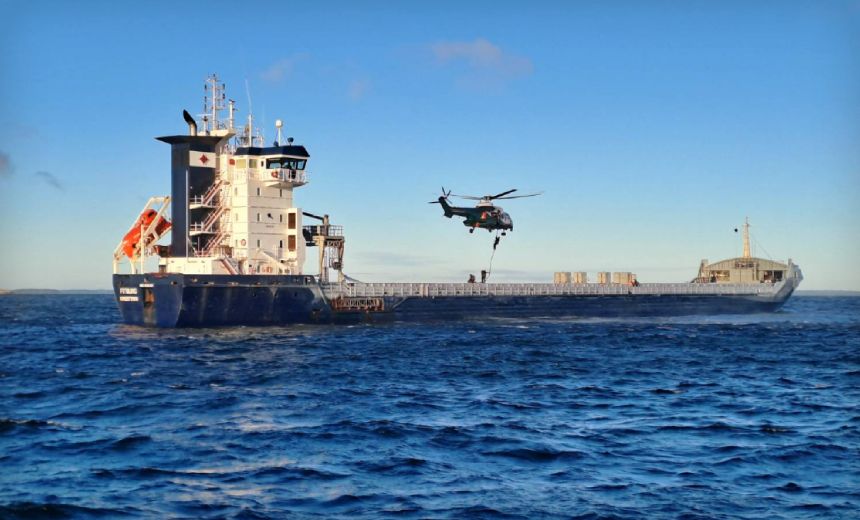
Finnish police on Wednesday seized a cargo ship sailing from Russia suspected of rupturing an undersea telecommunication cable connecting Helsinki to Estonia, a region of the Baltic Sea that is the site of a slew of suspected Russian cable sabotage incidents.
Elisa, a Finnish telecommunication service provider, said Wednesday that damage to the cable did not disrupt service. Elisa reports having 2.8 million customers, including government offices in Finland and Estonia.
The Finnish Border Guard on Wednesday said it boarded a vessel identified as Fitburg, which is suspected of instigating the damage when it was within the Estonian economic zone. The cargo ship was found with its anchor lowered.
“Finnish authorities have taken control of the vessel as part of a joint operation. Responsibility for leading the investigation has been transferred from the Gulf of Finland Coast Guard to the Helsinki Police Department,” the Finnish Border Guard said.
The vessel, crewed by 14, was sailing from Russia to Israel. The crew members included Russian, Georgian, Kazakh and Azerbaijani nationals. The general cargo ship is legally registered in the Caribbean island of St Vincent & Grenadines.
Authorities are investigating the incident as “aggravated criminal damage, attempted aggravated criminal damage, and aggravated interference with telecommunications.”
“Hopefully it was not a deliberate act, but the investigation will clarify,” tweeted Estonian President Alar Karis.
The incident is the latest in a number of undersea cable disruptions, which have significantly spiked since the Russian invasion of Ukraine in 2022. An estimated 10 subsea cables that connect the NATO-member dominated Baltic Sea region have been cut since 2022.
The Finnish government seized the Eagle S, an Emirate ship that set sail from the Russian port of Ust-Luga over suspected sabotage of EstLink 2 telecommunications and electricity cables between Finland and Estonia (see: Finland Suspects Eight in Deep-Sea Cable Sabotage Incident).
The Helsinki District Court ruled in October that the Finnish Criminal Code could not be applied due to restrictions arising from the United Nations Convention on the Law of the Sea, a ruling appealed by the deputy prosecutor general.
European concern about Russian threats have steadily mounted as the Kremlin has intensified a campaign of sabotage, hacking and disinformation across the continent, tactics designed to undermine national security without provoking an armed response.
These threats are a “coherent and escalating campaign to unsettle our citizens,” European Commission President Ursula von der Leyen warned in October.
“Tackling Russia’s hybrid war is not only about traditional defense. This requires a completely new mindset for all of us. We must be ready to leave our comfort zone. We need to explore new ways of doing things. And, most importantly, we must deter everyone who seeks to harm our territory and our people,” von der Leyen said.
U.S lawmakers in November introduced legislation aimed at fortifying defenses against potential Chinese and Russian sabotage (see: Congress Moves to Defend Undersea Cables From China, Russia).