

Artificial Intelligence & Machine Learning
,
Next-Generation Technologies & Secure Development
Blueprint Model From Ex-CrowdStrike Product Leader Targets MCP Servers, Cost Sprawl
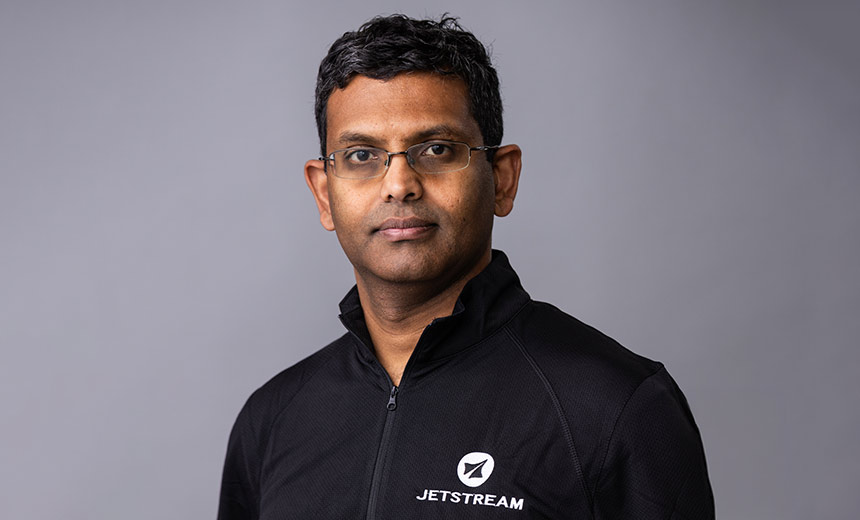
An artificial intelligence governance startup founded by CrowdStrike’s former chief product officer raised $34 million to provide visibility into how AI systems behave in production.
See Also: AI Is Transforming the Chief Data Officer Role
The Redpoint Ventures-led seed round will help San Francisco-based JetStream bring visibility, design control, enforcement and financial accountability to autonomous AI activity, according to co-founder and CEO Raj Rajamani. JetStream plans to address concerns around model context protocol server sprawl, key sprawl and AI cost management, and focus efforts on mapping AI assets across clouds, SaaS vendors and endpoints.
“There are various reasons which contribute to the trust deficit,” Rajamani told Information Security Media Group. “Senior leaders, whether it’s a CISO or CIO, do not have enough visibility and controls to get a full, thorough handle of everything that is AI that is happening within their enterprise.”
JetStream Security, founded in 2025, employs 40 people and received money from CrowdStrike CEO George Kurtz, Wiz CEO Assaf Rappaport and Okta co-founder Frederic Kerrest. The company was led since inception by Rajamani, who spent two years as CrowdStrike’s chief product officer, five years as SentinelOne’s chief product officer and three years as Cylance’s vice president of product management (see: Microsoft, Palo Alto, CrowdStrike Lead XDR Forrester Wave).
Why Trust Is the Primary Barrier to Scaling AI
Rajamani said the primary barrier to scaling AI is not model performance or infrastructure limitations, but organizational discomfort with transparency, control and predictability. Firms struggle with AI’s non-deterministic behavior, and the fact that identical prompts can produce different outputs reinforces skepticism among CISOs and CIOs who are responsible for operational and compliance accountability.
“Companies have a trust problem with AI,” Rajamani said. “And how do you actually enhance trust? You enhance trust by opening up that black box that is AI and giving everyone the transparency that they need to understand how these systems work. And blueprints do exactly that. They help you understand details that a naked eye may not pick up on.”
JetStream’s blueprints are a structured representation of what agents are doing, what tools and services they call, what data they touch, what identities and permissions they operate under, and when and how those interactions occur. From there, the blueprint defines an authorized purpose and lets JetStream detect or flag deviations when an autonomous system strays outside its intended swim lane.
Many vendors solve for narrow slices of AI governance such as MCP governance, shadow AI detection and cost management, but do so in isolation, Rajamani said. But when governance is split across consoles, attackers or insiders can exploit the in-between gaps to remain unnoticed, he said.
“Everyone else was solving for very important parts of the problem, but our thesis is that most large customers will not put three or five different solutions to solve for AI governance,” Rajamani said. “They will want one AI governance platform that covers visibility, design, control, financial operations. There is also a huge question around providing a kill switch to customers in case something goes out of hand.”
Why MCP Server Proliferation, Key Sprawl Are So Vexing
MCP server proliferation is one of the most pressing concerns among customers since developers can download and install servers locally, which introduces supply chain risks, unknown vulnerabilities and unvetted integrations. Related is key sprawl, since keys accidentally committed to public repositories can be quickly exploited for economic abuse, such as unauthorized token usage or image generation.
“The number one issue I’m hearing from our customers is, ‘How do we control the proliferation and sprawl of MCP servers?'” Rajamani said. “So that’s one simple use case. And if you survey the market, there are probably 10 companies which are super well-funded to go solve just for the MCP governance aspect.”
Most enterprises believe they are standardized on a single AI provider such as Microsoft Copilot or Google Gemini, but in practice, they’re not. “The reality is that it’s a very, very fragmented landscape,” Rajamani said. “Many of them do not even provide a detailed breakdown into exactly how many tokens are being used and what the costs are. And sometimes you just receive an invoice a month later, and sometimes you’re surprised.”
JetStream’s differentiation, in his telling, is that blueprints translate the complexity into understandable, enforceable constructs. He also claims additional security-centric capabilities around MCP related to enforcement mechanisms.
“Not only are we giving you those 5,000 jigsaw pieces, we also put them together into 50 blueprints, which you look at and say, ‘Oh yeah, I totally understand what this is trying to do,'” Rajamani said. “We also have enforcement capabilities which help you control MCP proliferation or key sprawl for MCP. We have built a verified MCP catalog where we do some very deep scans of any MCP server.”