

Government
,
Industry Specific
Trump Says Combat Targets Regime in Tehran, As Iran Responds With Missile Attacks
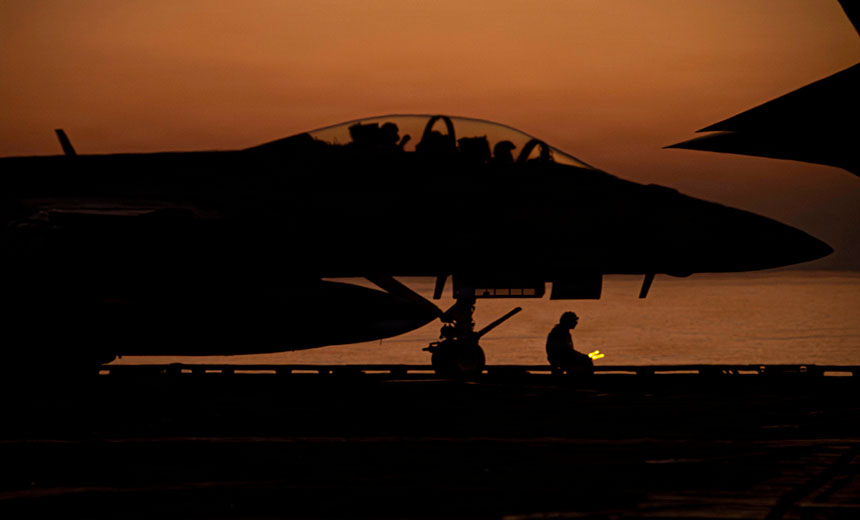
The United States and Israel have launched attacks on Iran.
See Also: New Trend in Federal Cybersecurity: Streamlining Efficiency with a Holistic IT Approach eBook
U.S. President Donald Trump on Saturday announced the launch of “major combat operations in Iran” that target the ruling regime in Tehran, where local media reports explosions have been heard.
The attacks began Friday night in response to “imminent threats from the Iranian regime,” after it “attempted to rebuild their nuclear program,” Trump said in a video speech posted to social media.
“We will ensure that Iran does not obtain a nuclear weapon,” he said. “We’re going to annihilate their navy. We are going to destroy their missiles and raze their missile industry to the ground.”
Iran on Saturday launched retaliatory ballistic missile attacks targeting U.S. military bases in Bahrain and Qatar. Multiple airlines on Saturday canceled flights to parts of the Middle East, including to Dubai, Tel Aviv in Israel and Beirut in Lebanon.
Already since the start of the conflict, pro-Tehran hackers have threatened Israel and the United Arab Emirates, the social platform X has blocked Iranian bots and multiple Iranian news agencies have been hacked, said Will Thomas, a senior threat intelligence adviser at Team Cymru, in a LinkedIn post.
“Every modern conflict nowadays has a cyber angle, and you can expect the recent conflict between Iran, the U.S., Israel and the rest of the Gulf has one too,” he said.
Cybersecurity experts predicted that more focused Iranian reprisals online will soon follow. “When Russia invaded Ukraine we got to watch and study their cyberattack capabilities. Now when Iran attacks the USA we get to study their capabilities first hand,” said Jeff Moss, the founder of the Black Hat and Def Con conferences, in a post to social network Mastodon.
“Be kind to your incident response and threat hunting teams!” he said.
Iranian media on Saturday reported that internet access, as well as mobile telephone and text messaging services, have been gradually cut off across the country.
“Network data show Iran is now in the midst of a near-total internet blackout with national connectivity at 4% of ordinary levels,” reported London-based internet watchdog organization NetBlocks early Saturday.
“The incident comes amid U.S. and Israeli combat operations and matches measures used during last year’s war with Israel,” it said.
The U.S.-Israeli military action follows months of anti-Tehran protests in Iran that human rights groups said government forces have continued to violently crush, leading to thousands being killed or injured (see: Fresh Cyberespionage Operation Tied to Iranian Surveillance).
Trump in his speech directly addressed Iran’s Islamic Revolutionary Guard Corps, armed forces and police, calling on them to lay down their arms in return for “total immunity.”
He also addressed the people of Iran, telling them “that the hour of your freedom is at hand,” and called on them when the attacks concluded to “take over your government.”
The combat operations follow the largest buildup of American forces in the Middle East since 2003, ahead of the U.S.-led invasion of Iraq.
Iran’s Foreign Affairs Ministry said in a statement Saturday that its armed forces remained “fully prepared” to respond to the joint U.S. and Israeli attacks.
Iranian officials said the start of the campaign, involving missiles launched by Israel, targeted its “territorial integrity and national sovereignty, including defensive infrastructure and non-military locations in various cities across the country.”
Security experts see shortcomings in Iran’s defensive capabilities. “Tehran’s skies have been left wide open to attack because of the failure of Russia to deliver last year the advanced air defense systems Iran requested. They are needed for Ukraine,” said William Dixon, senior associate fellow for cyber and international security at British think tank Royal United Services Institute (see: Incorporating Geopolitical Risk Into Your IT Strategy).
“You know who else didn’t get the Russian upgrades they ordered? Cuba. That is where this will move next,” he said.
The launch of the Friday campaign by the U.S. and Israel follows three rounds of high-stakes negotiations between U.S. and Iranian officials in Geneva over the future of the Iranian nuclear program. U.S. and Iranian officials Friday reported seeing “significant progress” in the talks. But Trump said he was “not happy” with what had been achieved.
The latest American military action follows U.S. forces in June 2025 launching a “Midnight Hammer” strike on three Iranian nuclear sites, which it said involved support from U.S. Cyber Command and multiple other combat commands, including U.S. Strategic Command, U.S. Space Command and the Space Force.
The U.S. military said the campaign inflected “extremely severe damage and destruction” on three Iranian nuclear sites.
While many details of the operation remain classified, cyber defense and national security analysts said U.S. military doctrine increasingly prioritizes combining cyber operations with conventional force tactics, to bolster physical attacks with digital support.
“After that attack, we warned them never to resume their malicious pursuit of nuclear weapons, and we sought repeatedly to make a deal,” Trump said in his Saturday speech.
“They rejected every opportunity to renounce their nuclear ambitions, and we can’t take it anymore,” he said.