

Agentic AI
,
Artificial Intelligence & Machine Learning
,
Governance & Risk Management
Why Human-Centric Zero Trust Models Fail in a World of Autonomous AI Agents
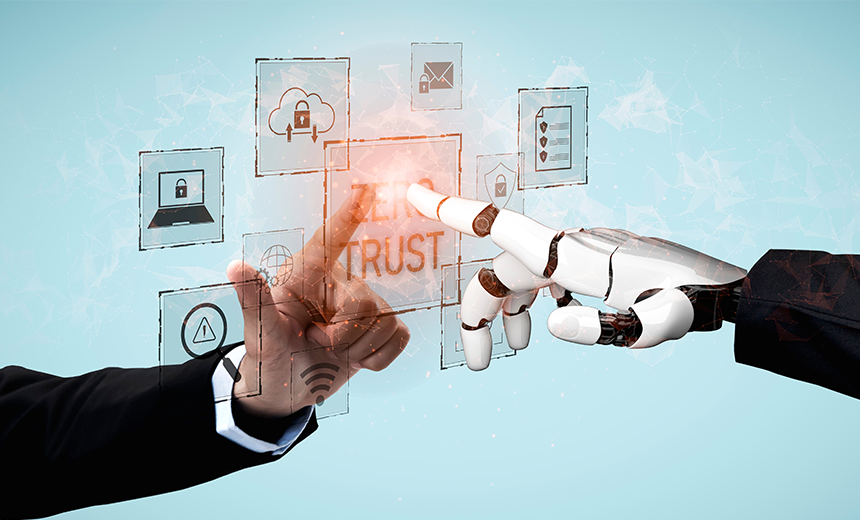
The cybersecurity landscape is currently witnessing a collision between two of the most transformative trends in technology: the mandated adoption of zero trust architectures and the rapid proliferation of autonomous artificial intelligence agents.
See Also: Going Beyond the Copilot Pilot – A CISO’s Perspective
For years, the mantra of “never trust, always verify” has served as the bedrock of modern defense, designed primarily to govern human users and their devices. But as organizations transition from basic generative AI to “agentic” workflows – where AI entities autonomously navigate systems, access databases and execute multi-step tasks – the traditional zero trust model is reaching its breaking point.
The numbers tell a stark story: The global AI agents market reached $7.63 billion in 2025 and is projected to hit $50.31 billion by 2030. As per a McKinsey report, 88% of organizations now use AI in at least one function, up from 55% in 2023. This explosion spans enterprise software, consumer applications and IoT devices alike. Yet Gartner warns that by 2028, 25% of security breaches will be traced back to AI agent abuse. From smart home devices to industrial systems, autonomous capabilities are outpacing security frameworks designed for a fundamentally different threat landscape.
The fundamental paradox is clear: To be useful, an AI agent often requires broad, cross-domain access that spans CRM systems, financial databases, internal APIs or even smart home ecosystems. To be secure, a zero trust model demands the strictest application of least privilege. Reconciling these two opposing forces is the next great challenge for modern security leaders.
The Collision: Why Traditional Zero Trust Fails AI Agents
The core tenets of zero trust – explicit identity verification, least-privilege access and microsegmentation – were built for a world of predictable human behavior. A human employee typically logs in from a known device, accesses a handful of applications and works within standard business hours. Traditional zero trust leverages multifactor authentication and device posture checks to validate these interactions.
AI agents, however, don’t fit this profile. They operate at machine speed, authenticate hundreds of times per second and do not possess “biometric” or “human” attributes. Their utility is derived from their ability to integrate data across silos. An agent tasked with “optimizing supply chain logistics” might legitimately need to query inventory databases, external weather APIs, shipping carrier portals and internal financial ledgers simultaneously.
If a security team applies traditional, static “least privilege” to this agent, the result is often a binary failure: either the agent is restricted so heavily that it cannot perform its task, or it is granted a privileged service account that becomes a catastrophic single point of failure.
Research on zero trust architecture emphasizes that the paradigm shift from perimeter-based to perimeterless security models has been essential for modern environments, but the arrival of autonomous agents necessitates a more granular, context-aware approach than what most systems have currently deployed.
The “Omnipresent” Risk: Automated Lateral Movement
The primary concern for security leaders is the “blast radius” of a compromised AI agent. In traditional environments, an attacker who compromises a human credential is often limited by the speed of manual discovery and the specific permissions of that user. CrowdStrike reports that human attackers typically have a “breakout time” of 1 hour and 58 minutes before beginning lateral movement. An AI agent, by design, operates at a fundamentally different scale – security researchers documented AI-driven attacks running at “sustained request rates of multiple operations per second,” with the autonomy to call APIs and move data at speeds that exceed human oversight by orders of magnitude.
The threat is no longer theoretical. In September 2025, Anthropic detected and disrupted the first reported AI-orchestrated espionage campaign, where attackers used AI’s agentic capabilities to execute cyberattacks at machine speed, making thousands of requests per second – a pace impossible for human hackers to match. In another incident, a healthcare provider discovered a compromised customer service AI agent had been leaking patient records for three months, costing the organization $14 million in fines and remediation.
The scale of exposure extends beyond enterprises. With over 30 billion IoT devices projected worldwide by 2025, consumer applications face similar risks. Smart home AI agents controlling locks, cameras and personal data create new attack vectors at scale.
IBM’s 2025 Cost of a Data Breach Report reveals that 13% of organizations reported breaches of AI models or applications, with 97% lacking proper AI access controls. Shadow AI breaches cost an average of $670,000 more than traditional incidents and affected one in five organizations in 2025.
Building Autonomous Zero Trust: A Four-Pillar Framework
The challenges posed by AI agents cannot be solved with a single technology or policy change. Traditional zero trust relied heavily on perimeter controls and static policies because the entities it governed – human users – operated within predictable patterns and at human speed. AI agents shatter these assumptions entirely.
What’s needed is a comprehensive, layered approach that addresses four fundamental dimensions of the AI agent security problem:
- Identity – who or what is the agent?
- Authorization – what should it be allowed to do right now?
- Containment – what’s the damage if it’s compromised?
- Governance – how do we maintain visibility and control as agents proliferate?
Each pillar addresses a distinct failure mode, and critically, no single pillar can stand alone.
Strong machine identity without dynamic authorization still leaves agents over-privileged. Dynamic authorization without microsegmentation means a compromised agent can still pivot laterally. Microsegmentation without governance means you’re securing known agents while shadow deployments multiply unchecked. Only by implementing all four pillars in concert can organizations achieve true autonomous zero trust – a security posture that matches the speed, scale and complexity of AI-driven operations.
Part 2 of this blog will examine how organizations can operationalize autonomous zero trust in practice.