

Agentic AI
,
Artificial Intelligence & Machine Learning
,
Litigation
Frontier AI Developer Says Enterprise Customers Could Mistake the Two Brands
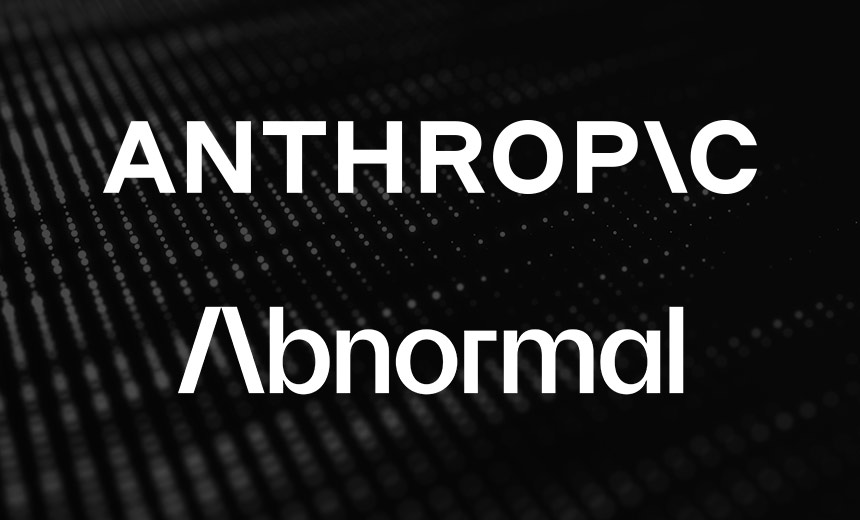
Anthropic sued business partner and competitor Abnormal AI and accused the company of adopting a logo and branding that are confusingly similar to Anthropic’s visual identity.
See Also: AI Agents Introduce a New Insider Threat Model
The San Francisco-based frontier artificial intelligence lab said it increasingly competes with Las Vegas-based Abnormal on AI security products and services, and offered Abnormal time to transition to a different logo, but Abnormal declined. Abnormal said its banding predates the timeline alleged by Anthropic, and that no customer has ever purchased Abnormal’s products believing they were buying from Anthropic.
“This case arises from Abnormal’s efforts to rebrand itself around Anthropic’s distinctive commercial identity while competing in the same market for AI-powered enterprise security where Anthropic has already built substantial goodwill under its marks,” Anthropic wrote in a 31-page complaint filed July 1 in U.S. District Court for the Northern District of California.
Abnormal CEO Evan Reiser said Anthropic’s lawsuit came as a big surprise since he is a major user and advocate, saying in a blog posted Tuesday he expects to spend $1 million from his personal Anthropic account this year while Abnormal as a whole will spend more than $10 million. Most companies decline to speak about ongoing litigation outside court filings, making Reiser’s blog and LinkedIn post unusual.
“We’re a very large customer of Anthropic and they still have yet to tell us about the lawsuit,” Reiser wrote in the blog. “I learned about it from a reporter, not our ‘partner.'”
Despite Being Anthropic User, Abnormal Partnership Is Limited
Despite Abnormal being a big user of Anthropic, the two companies don’t appear to have deep technical ties. Abnormal hasn’t been disclosed as one of the 200 vendors participating in Anthropic’s Project Glasswing software defense initiative, a group that includes broad cybersecurity players including Cisco, CrowdStrike and Palo Alto Networks as well as more specialized firms such as Okta and Rubrik (see: Anthropic Expands Mythos to Global Critical Infrastructure).
Anthropic offers integrations to 60 notable security and compliance tools through Claude Compliance API, including email security competitors of Abnormal such as Proofpoint and Mimecast. But Abnormal isn’t on the list. OpenAI, meanwhile, allowed 30 cybersecurity vendors and service providers to integrate GPT-5.5 capabilities into their products and services. Proofpoint is on that list, but Abnormal isn’t (see: OpenAI Lets Cyber Vendors Embed GPT-5.5 in Defenses).
Abnormal is significantly larger than many of the security vendors with integrations into Anthropic and OpenAI. The company has more than $200 million in annual recurring revenue, a $5.1 billion valuation and more than 1,550 employees (see: Abnormal Security Secures $250M for AI Cybersecurity Growth).
While Abnormal existed before Anthropic, Anthropic alleges Abnormal’s April 2025 comprehensive rebrand moved the company toward branding that closely resembles Anthropic’s distinctive visual identity and messaging. Abnormal countered that its slash-based branding currently in use was designed in April 2021, and the company has used essentially the same wordmark for approximately five years.
“We built our own AI models, our own technology architecture, and our own behavioral approach for cybersecurity because the old way was failing customers,” Reiser wrote in the blog. “That is why the accusation that we copied another company to deceive customers is so personally offensive. It is the opposite of who we are.”
Anthropic said both companies increasingly market AI-powered enterprise software to overlapping audiences that include CISOs, developers, procurement teams and enterprise technology leaders. Abnormal said it sells specialized behavioral AI security products while Anthropic develops general-purpose large language models, making confusion by sophisticated enterprise clients implausible.
“Anthropic and Abnormal both market AI-powered software to the same enterprise audiences, including security leaders, developers, and procurement teams,” Anthropic said. “By the time Abnormal unveiled its new identity in April 2025, Anthropic had already spent years building a public cybersecurity presence under the Anthropic Marks through research, conferences, government-backed cyber competitions.”
Companies Disagree Over Whether Similar Logos Cause Confusion
Anthropic said its progression from AI safety research into cybersecurity offerings such as Claude Security and Project Glasswing put the two companies in increasingly similar commercial markets. Abnormal emphasized that, unlike Anthropic, it is not an LLM provider and that its autonomous threat detection operates independently of Anthropic’s models.
“Anthropic builds general-purpose AI language models,” Reiser wrote in the blog. “Abnormal builds specialized behavioral AI models to understand enterprise behavior and stop cyber attacks. These are different technologies for different jobs. We do not rely on Anthropic, Claude, or any other third-party AI for autonomous threat detection and response.”
Reiser expressed surprise that Anthropic filed suit despite Abnormal being what he describes as one of Anthropic’s largest customers. Anthropic in its complaint acknowledged the business relationship but argued it actually demonstrates Abnormal’s familiarity with Anthropic’s brand.
“Abnormal was not built by copying or confusion,” Reiser wrote in the blog. “It was built on trust, innovation and commitment to ensure that our behaviors are aligned with our values and mission to stop crime.”
Anthropic argued that Abnormal publicly promotes both its internal reliance on Claude and its AI-native positioning while adopting branding that Anthropic believes resembles its own, thereby increasing the likelihood that enterprise customers could perceive some form of affiliation. Abnormal repeatedly emphasizes that its security platform relies on internally developed behavioral AI rather than Claude.
“Both parties offer AI-powered enterprise software products and services that are similar in use and function, are promoted to an overlapping class of consumers and are at minimum complementary,” Anthropic wrote. “Abnormal’s own platform is powered in part by Anthropic’s Claude software, meaning Abnormal adopted a near-identical mark for offerings built in part on Anthropic’s own technology.”