

Artificial Intelligence & Machine Learning
,
Governance & Risk Management
,
Next-Generation Technologies & Secure Development
Vendor Combines AI Attack Agents, Human Experts to Simulate Real-World Cyberattacks
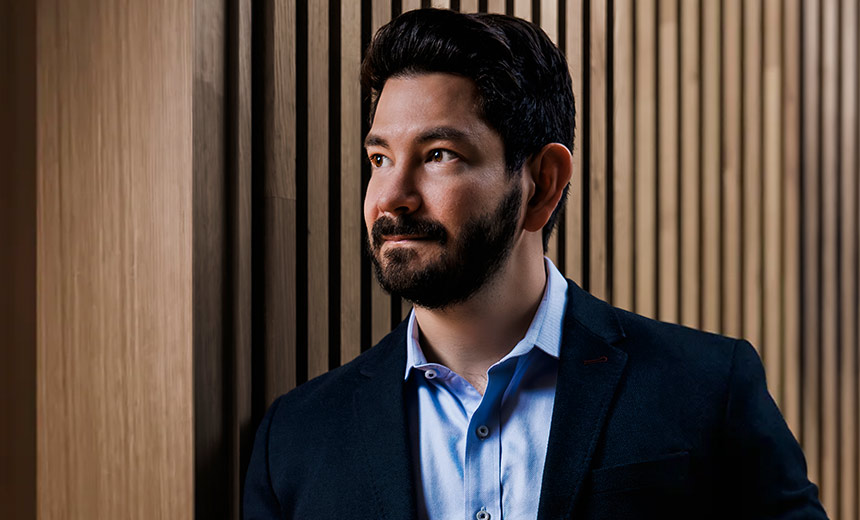
A startup led by Kevin Mandia emerged from stealth with nearly $190 million to transform penetration testing and red-teaming through autonomous artificial intelligence agents.
See Also: AI or Data Governance? Gartner Says You Need Both
The Accel-led Seed and Series A rounds will help San Francisco-based Armadin develop AI agents trained on expert red-team methodologies to continuously test environments at scale, said co-founder and Chief Offensive Security Officer Evan Pena. He said agent orchestration, swarm architectures and inter-agent communication protocols are now able to replicate complex offensive security workflows.
“A lot of what you were seeing was mostly around chatbots and LLMs taking in a lot of text and being able to give you advice and reporting,” Pena told Information Security Media Group. “Now, you can orchestrate tasks and actually execute on some of those tasks. So you had chats, then going into actual execution.”
The company is led by Mandia, who previously spent two decades at threat intelligence and incident response firm Mandiant. He first sold Mandiant to FireEye in 2013, became FireEye’s CEO in 2016, sold the company’s product portfolio to Symphony Technology Group for $1.2 billion in 2021 and then sold the services business – renamed Mandiant – to Google for $5.4 billion in 2022. He left Google in 2024 (see: Kevin Mandia Exits Mandiant CEO Role After Google Purchase).
How Agent-to-Agent Communications Enable Offensive Cyber
Agent-to-agent communication protocols enable multiple AI entities to coordinate attacks in different domains such as web applications, external infrastructure and internal networks, meaning attacks can be conducted in parallel rather than sequentially. Traditional engagements may identify a single successful attack path, but an AI-powered system can discover dozens or hundreds of potential paths.
“What we’re doing right now is two things on the red-team side,” Pena said. “The first one is going to be training the agents to do what it is that we do, the way that we do it.”
Human red-teamers encode their methodologies into formats that AI systems can understand and execute since they have years of experience performing penetration tests, understanding attacker behavior and developing specialized tools, Pena said. The team documents attack methodologies, tools and decision-making processes, Pena said, including the reasoning behind specific actions.
“A frontier model out of the box, if you tell it, ‘Hey, go hack this thing,” it may just not work,” Pena said. “It has to have fine tuning, it has to have methodology. It has to have tools available to it that allow it to actually execute on things. And so red-teamers provide a lot of that value.”
Human pen testing teams naturally prioritize the path of least resistance, meaning once an attacker finds one viable route into a system, the engagement often ends and many other potential attack paths stay unexplored, he said. Instead of performing a single test each year, AI-driven systems can evaluate systems continuously and explore far more attack paths than human teams alone could manage.
“I’ve been doing this my whole career, assessing security networks across one enterprise,” Pena said. “We’re almost always successful. And the reason why is just because it’s always been human-led. We do it once a year, we take the path of least resistance. We accomplish that mission. Give them a report, we walk away.”
How Armadin Plans to Address Vulnerability Remediation
In the future, AI agents will continuously run attacks, identify vulnerabilities and analyze attack paths, with human experts reviewing AI findings, validating complex attack chains and looking for novel techniques that the system has not yet discovered. When humans identify new attack strategies, these techniques can be added to the AI system’s playbook, making the AI progressively more capable.
“I don’t see the point in doing a human-led assessment anymore unless it’s extremely bespoke because AI is just able to do it much quicker with precision, and it’s able to scale this in a significant way,” Pena said. “You don’t have enough coverage with humans. You have to do it with AI agents.”
Armadin aims to solve remediation bottlenecks by analyzing attack paths and spotting the vulnerabilities that have the greatest business impact, with the platform prioritizing remediation based on which issues would eliminate entire attack chains. AI may eventually do automated remediation, but automatically resetting accounts, modifying configurations, or reimaging systems could disrupt business operations.
“We want to be able to give you a path forward, we want to be able to really help you enhance your security posture,” Pena said. “We want to be able to help you fix them. And so the platform will provide you tactical recommit recommendations and strategic recommendations to enhance your security posture and, more importantly, remediate those findings.”
By orchestrating multiple attacks across an entire attack life cycle, AI agents can quickly test whether detection systems successfully identify malicious behavior, Pena said. If a defensive system fails to detect a specific attack technique, AI could generate detection rules that can be integrated into SIEM or EDR platforms. This relies on structured schemas and technical documentation, which AI models handle well.
“With each of our evaluations, we have the human operator do it, we have my team do it manually, and then we have the AI do it, and we compare,” Pena said. “We want to see how much of a force multiplier AI is. Is it able to do it 80% faster, for example, than the way we were able to do it when we did manually?”