

Commission VP Henna Virkkunen Pledges Action in Tuesday Parliamentary Session
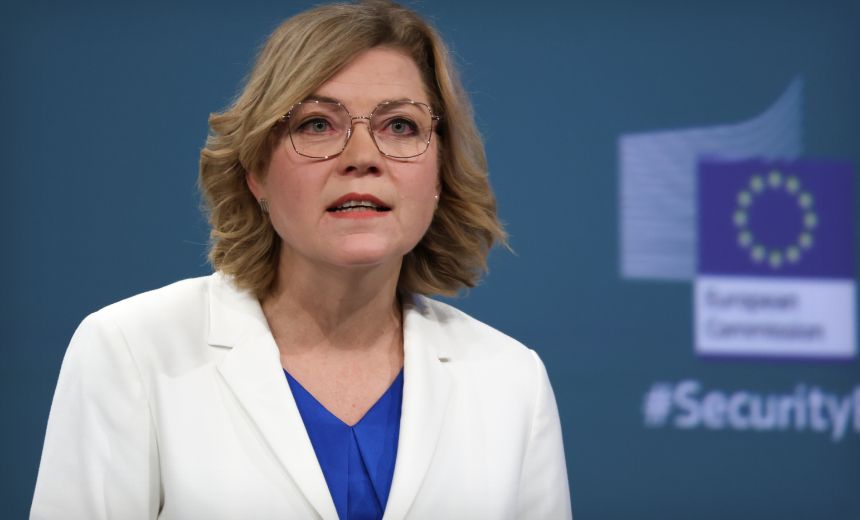
The European Commission is defending its response to the advent of artificial intelligence models with strong cybersecurity bug dissecting capabilities while promising measures to protect the European Union from what many expect to be an imminent onslaught of AI-powered attacks.
See Also: AI Impersonation Is the New Arms Race-Is Your Workforce Ready?
Two weeks after dozens of lawmakers demanded urgent action – including obtaining access to Anthropic’s hacking-capable Mythos model – commission Vice President Henna Virkkunen told the European Parliament the EU already has tools to handle the situation.
Virkkunen during a Tuesday parliamentary session said the commission will investigate activating the EU Cybersecurity Reserve – the pool of cybersecurity service providers that can be deployed during a crisis.
“We have not waited for these models to appear to anticipate future cybersecurity capabilities,” she said. She also promised to “present a list of actions in the coming weeks, bringing together the best EU expertise in AI and cybersecurity,” to “ramp up our preparedness in the face of emerging AI threats.”
The EU’s top tech official said than upcoming Tech Sovereignty Package legislative proposal – expected later this month – will include language for “ensuring the maintenance, security and integrity of our open-source digital infrastructures, that are coming under increased cybersecurity pressure resulting from the weaponization of AI.”
Virkkunen also took the opportunity to call for the Parliament to approve the commission’s existing proposal for revisions to the Cybersecurity Act, arguing that this would “equip ENISA and the commission with the resources, powers and clarity of mandate that this new threat picture is requiring.” She also urged EU countries to get on with transposing the Network and Information Security 2 Directive, which places cybersecurity obligations on critical infrastructure providers, into their national laws (see: European States Spin Wheels on Cybersecurity Directive).
As for European access to Mythos, Virkkunen said the providers of such advanced AI models are “essential to safeguarding our critical infrastructure” in the current geopolitical context, but didn’t offer any kind of update regarding why Anthropic refuses to allow access. She said public and private European organizations must rapidly adopt “already-available advanced cyber tools” to harden their defenses.
“There is no reason to wait, and this is crucial for preparing for the upcoming risks,” Virkkunen said.
OpenAI, Anthropic’s chief rival, last week stepped in to let some European authorities – including the commission – and companies gain access to its new GPT-5.5-Cyber model, which is roughly in the same class of capability as Mythos (see: OpenAI Unlocks Cybersecurity Model for Europe).
France’s Mistral, which is Europe’s only player when it comes to frontier AI – though it remains behind its biggest U.S. rivals – has reportedly developed a hacking-capable model that it may give to big European banks. There is a distinct panic in the European financial sector at the moment, regarding the danger that is likely looming (see: ECB: AI Means European Banks Must Hasten Cybersecurity Pace).
In her speech on Tuesday, Virkkunen said Europe does “not want to remain dependent on others’ cyber-defense tools” and must do more to nurture its own cybersecurity ecosystem “so that in Europe we have the right conditions for sustainable cybersecurity business models to meet the challenges of today and tomorrow.” But she didn’t offer any suggestions as to how this should be achieved.
Marilena Raouna, a Cypriot deputy minister speaking on behalf of the EU member states – Cyprus currently holds the presidency of the Council of the EU – also touched on the sovereignty topic in her speech at the parliamentary session.
“Today Europe remains highly dependent on external actors for critical cloud infrastructure, semiconductor supply chains, advanced computing resources, or cybersecurity tools,” Raouna said. “This dependency is occurring in the context of an increasingly strategic global competition around advanced AI capability. In this context we look forward to the upcoming Tech Sovereignty Package announced by the commission. This will be an integral part of our overall strategic autonomy.”
Some of the members of the European Parliament who spoke Tuesday called for more urgent actions, such as the mandatory implementation of red-teaming, the establishment of a certification scheme for AI cyber tools and even the activation of the EU’s integrated political crisis response – a mechanism currently used to coordinate crises such as Russia’s war against Ukraine and the situation in the Middle East. Commission representatives did not responded to those suggestions.