

Artificial Intelligence & Machine Learning
,
Government
,
Industry Specific
Pentagon Expands Frontier AI Providers Amid Anthropic Legal Fight
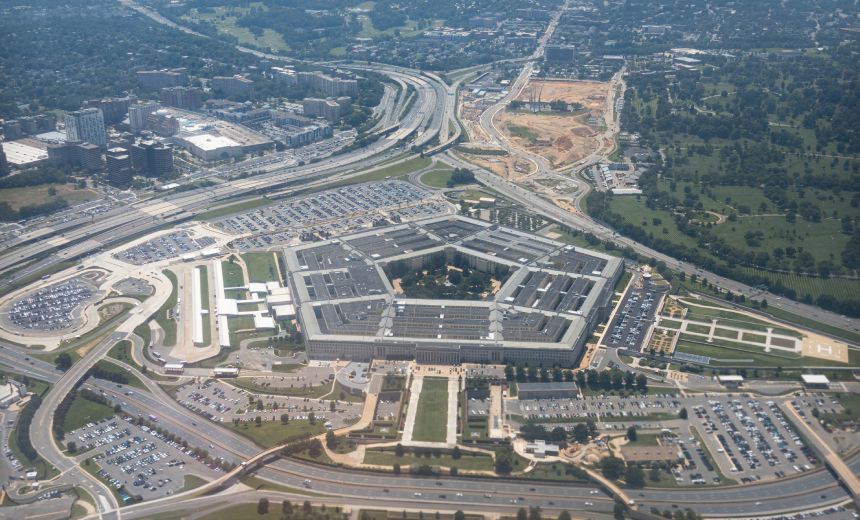
The U.S. Department of Defense top research and engineering official said Thursday the Pentagon will no longer rely on a single artificial intelligence provider, doubling down on the administration’s split with Anthropic as federal agencies race to expand the use of frontier AI systems across cyber and national security operations.
See Also: New Trend in Federal Cybersecurity: Streamlining Efficiency with a Holistic IT Approach
“We were single-threaded on one vendor, one AI vendor at the Department of War,” Under Secretary of Defense for Research and Engineering Emil Michael said Thursday during remarks at the Special Competitive Studies Project’s AI+ Expo event. “These are sophisticated, protective systems that take a lot of work to integrate on, so it wasn’t like I could just turn on a few other models that easily.”
“But never again we’ll be single-threaded with any one model,” he added.
Michael’s remarks come amid a legal and policy dispute with Anthropic over the use of its systems in military and intelligence environments. The administration’s broader conflict with Anthropic amid the release of its powerful Mythos model has become an early test of whether the federal government can reduce dependence on major AI vendors without limiting access to technologies officials increasingly view as critical to cyber defense, intelligence analysis and military operations.
The dispute intersects with several major policy discussions underway inside Washington, including a draft national security AI memo, reported discussions around possible federal pre-release reviews for advanced AI models and new government testing agreements with major AI developers.
Current and former federal officials said the Pentagon’s recent efforts to broaden its AI supplier base reflect growing concern that advanced AI systems are becoming deeply embedded across defense and intelligence operations before the government has established mature standards governing testing, procurement and operational control.
The Pentagon recently announced agreements with multiple AI companies to expand frontier AI deployments across classified environments, a move widely viewed as an effort to reduce reliance on Anthropic while maintaining access to advanced AI capabilities for national security missions (see: Pentagon’s Anthropic Fight Draws Rebuke From Ex-DOD Leaders).
Michael’s remarks also align with broader administration efforts to push agencies away from dependence on any single AI provider.
New reporting shows the White House is preparing updated national security guidance expected to direct agencies to diversify AI vendors while establishing clearer rules around how advanced systems are deployed across military and intelligence environments. The White House is also reportedly considering whether frontier AI systems should undergo formal government review before deployment or release amid growing concern that the same models capable of improving cyber defense could also accelerate vulnerability discovery, exploit development and offensive cyber operations.
The Trump administration’s conflict with Anthropic escalated earlier this year after the Defense Department designated the company a supply-chain risk and moved to restrict its systems from defense environments, prompting an ongoing legal battle between the company and the government (see: Court Backs Pentagon Anthropic Ban – But the Fight Continues).
Anthropic has disputed the government’s claims in court filings, arguing that once its systems are deployed inside secure government environments, the company has no technical ability to remotely alter, disable or interfere with them.