

Election Security
,
Fraud Management & Cybercrime
,
Government
Courts, Audits and Federal Agencies Found No Evidence 2020 Votes Were Altered
U.S. President Donald Trump used a primetime address Thursday night to allege that China carried out a sweeping compromise of American voter data and to revive doubts about the 2020 election, while stopping short of claiming any votes were changed – an allegation his own government, more than 60 courts and multiple statewide probes have already tested and rejected.
See Also: New Attacks. Skyrocketing Costs. The True Cost of a Security Breach.
Speaking from the East Room for nearly a half hour, Trump pointed to newly declassified documents posted to the White House website that he said cover “five major areas of concern,” alleging that beginning in the 2020 election cycle China carried out “the largest compromise of election data in history” through the “illicit acquisition of 220 million U.S. voter files.”
The president said the files included names, addresses, phone numbers and party preferences, describing the episode as “an unprecedented election security nightmare.” He accused officials of concealing the intelligence from him, Congress and the public, claiming “members of the deep state” worked “to actively suppress and downplay information” about Beijing’s activities.
Voter registration data is frequently public record in the U.S. and available commercially, and access to that information does not by itself allow anyone to alter votes or election outcomes. A previously declassified 2020 intelligence assessment found China had obtained voter registration data from multiple states to conduct public opinion analysis on that year’s election.
A White House official said ahead of the address that the declassified materials were not expected to include any allegations that actual votes were changed or voting machines were hacked in 2020 – claims the president has repeated for years without evidence.
“We judge that Russia, China, Iran, as well as many nonstate actors, have the capability to conduct such activities,” one document states, “although it would be difficult for them to manipulate voting processes at scale and without detection.”
The 2020 election also remains among the most heavily scrutinized voting cycles in the United States, with investigations, court findings and statewide probes concluding it was one of the most secure in history.
Trump’s own Cybersecurity and Infrastructure Security Agency said as much in a joint statement with state and local election officials at the time, describing the 2020 election as “the most secure in American history” and finding no evidence any voting system deleted, lost or changed votes. Trump fired CISA Director Christopher Krebs days later for refuting his fraud claims.
A National Intelligence Council assessment declassified in March 2021 found no indications any foreign actor attempted to alter any technical aspect of the voting process in 2020, including voter registration, ballot casting, vote tabulation or the reporting of results. Then-Attorney General William Barr also said at the time that the Department of Justice had uncovered no fraud on a scale that would have changed the outcome.
Another council assessment, declassified this month by Trump, stated that foreign hackers could be capable of hacking some voting machines, “but it probably would be difficult to coordinate a campaign to alter voting results on a wide scale. Post-election audits and paper trails also most likely would uncover such efforts in the nearly all U.S. states. Similarly, foreign actors would have difficulty coordinating a large scale campaign to manipulate mail-in voting, and robust postal tracking probably would detect any large-scale effort.”
Federal judges – including several appointed by Trump – dismissed or rejected more than 60 lawsuits challenging the 2020 results for lack of evidence. Fox News later paid Dominion Voting Systems $787.5 million to settle a defamation suit over stolen-election claims broadcast on its airwaves. A federal jury also ordered Trump attorney Rudy Giuliani to pay $148 million to two Georgia election workers he falsely accused of manipulating ballots.
Georgia counted its roughly 5 million presidential ballots three times, including a full hand tally of paper ballots, and each count confirmed the result. Arizona’s Republican-commissioned review of Maricopa County ballots also affirmed the outcome.
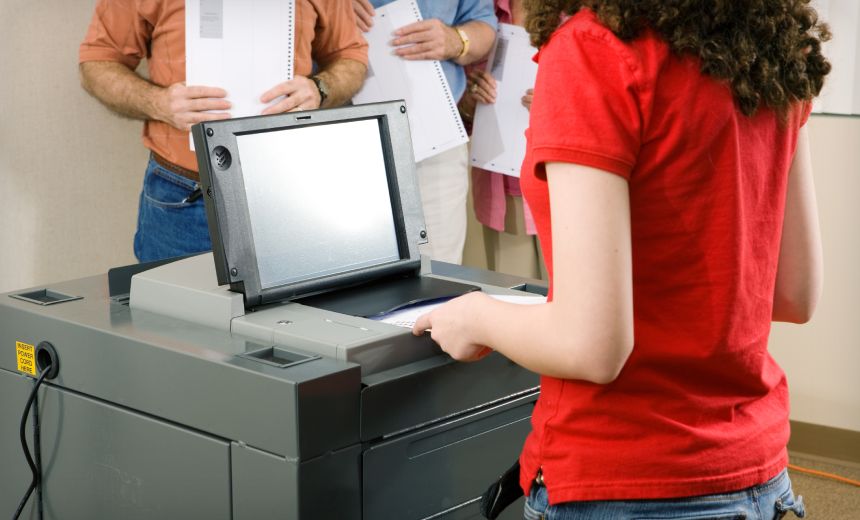
Security experts say the architecture of U.S. voting systems is what makes a remote hacking scenario – a foreign adversary in Moscow or Beijing silently manipulating votes – virtually impossible.
Election administration is decentralized and spread across thousands of jurisdictions running different equipment under different procedures, which experts say makes any large-scale attack extremely difficult to execute. Because there is no singular national system to breach, an adversary would need to compromise thousands of offline machines across multiple states without detection.
Voting systems are tested in federally accredited laboratories before deployment, undergoing stress tests and software checks against voluntary federal guidelines administered by the U.S. Election Assistance Commission. States then add on their own additional certification requirements and conduct accuracy testing, tamper-evident seals and chain of custody controls.
Nearly 95% of ballots cast in 2020 also carried a paper record, allowing officials to verify machine tallies against physical ballots. And a growing number of states have begun conducting risk-limiting audits, manually tallying a statistical sample of paper ballots to confirm the electronic count.
None of this means voting machines are flawless. But CISA’s own 2022 advisory on those flaws found no evidence they had ever been exploited in an election.
“Voting systems, like all critical infrastructure, have vulnerabilities,” Geoff Hale, who previously led CISA’s election security initiative and is now with the Center for Democracy and Technology, said in a statement sent to ISMG. “But just because a vulnerability exists doesn’t prove that it’s been exploited, let alone that an exploitation altered something technically during an election.”
“The public should be aware that neither a mountain of documents nor technically complex claims are enough to credibly prove that an election security incident actually occurred,” he added.
Thursday’s speech comes a week after Trump fired the three remaining EAC commissioners, leaving the agency that certifies voting systems without a quorum and unable to act. A White House official defended the firings, saying the president “reserves the right to remove individuals that may not be totally aligned with the important task of securing America’s elections and ensuring every legal vote is counted.”