

Agentic AI
,
Artificial Intelligence & Machine Learning
,
Next-Generation Technologies & Secure Development
Dell Conference Speakers Say 67% of AI Innovation Is Running Outside the Cloud
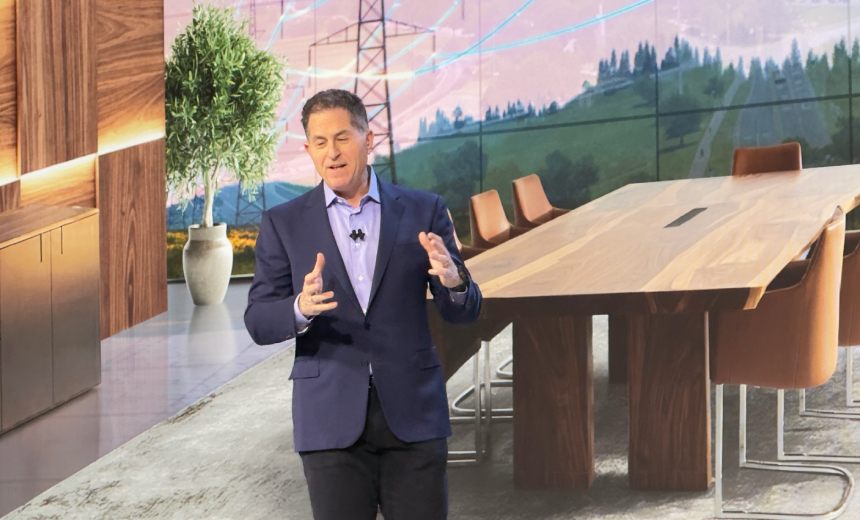
It’s a predictable conference story: A big vendor makes major announcements with the glamor of artificial intelligence everywhere.
See Also: AI Impersonation Is the New Arms Race-Is Your Workforce Ready?
But at Dell Technologies World 2026 in Las Vegas, a more fundamental point was made. Michael Dell, the founder, CEO, and chairman, argued that the key question in enterprise AI – where AI should run rather than which model to use – has been addressed mainly in favor of cloud providers.
But that figure warrants careful consideration. Dell predicts up to $4 trillion in AI infrastructure investment by 2030. According to Dell, 67% of AI workloads are already run outside the public cloud. If this estimate is even roughly correct, the idea that enterprise AI mainly exists in hyperscaler environments is more of a forced narrative than a market reality.
The Execution Gap Is the Real Story
The CEO acknowledged that most companies don’t struggle with AI ambitions but rather with AI implementation. This is a clear but somewhat uncomfortable point. Over the past three years, the industry has focused on pilots and demos, leading to many stalled/curtailed AI projects. These failures are commonly attributed to two key factors: data availability and data quality.
This is where Dell’s infrastructure argument shifts from vendor positioning to a valid systems-level argument. Mere AI models are as good as trash if an enterprise is constrained by a lack of AI-ready data infrastructure. Even the most advanced models can produce average results if they cannot reliably find, trust, or access the necessary data. In many enterprises, critical data such as operational, regulated or proprietary doesn’t reside in the cloud but remains on-prem, stored in legacy systems, manufacturing sites or research laboratories.
Dell’s solution seems structurally simple, even if the engineering effort is complex. It wants to deploy AI near the data instead of transferring data to the AI. This is an age-old principle, but building the infrastructure to do so at the scale of agentic AI is truly new.
What Dell Truly Announced
The DTW 2026 announcement portfolio was extensive. Viewed collectively, a clear thesis emerges.
At the workload layer, Dell’s Deskside Agentic AI was the most significant announcement. It signals a shift in the economics of agentic AI. While the claim that enterprises can recover costs from public cloud API expenses within three months needs careful scrutiny, the reasoning is sound. Agentic workflows generate cascading inference chains comprising reasoning steps, tool calls and validation loops, each step increasing token usage. As token volume grows exponentially, relying solely on cloud inference becomes financially unsustainable for workloads that will truly add enterprise value. Dell’s deskside model, combined with Nvidia NemoClaw and OpenShell, offers a solution to these rising costs and enhances data sovereignty.
Enhancements to the Dell AI Data Platform on the data layer are among the most understated announcements. They include indexing billions of unstructured files into managed pipelines, GPU-accelerated SQL analytics that deliver up to 6x faster queries with NVIDIA Blackwell, and integration with NVIDIA Omniverse for digital twin workflows. Appearing ordinary, these features directly tackle the execution gap highlighted in Dell’s keynote. Data preparation, discovery and governance are key areas where AI efforts often fail quietly.
At the infrastructure level, Dell PowerRack, PowerStore Elite, and its latest PowerEdge servers provide tailored solutions for evolving AI workloads. PowerStore Elite’s 6:1 data reduction guarantee and seamless non-disruptive upgrades are notable differentiators. These features target real operational risks, such as storage refresh cycles and vendor lock-in, not just theoretical issues. Further, Dell shipping over twice as many rack-scale servers as its closest competitor indicates the direction of enterprise purchasing decisions.
The Ecosystem Play Is Where It Gets Interesting
Dell’s partnership announcements, including Google Distributed Cloud, OpenAI Codex, Palantir, SpaceXAI’s Grok, Reflection, Hugging Face, Mistral, and ServiceNow, are deliberate responses to the long-standing on-premises AI deployment problem, which points towards access to frontier models.
The classic critique of on-prem AI is that it sacrifices agility and ease of access to models. Dell is directly challenging this. If businesses can host models like Gemini 3 Flash, OpenAI Codex, Grok and Mistral on their infrastructure, behind firewalls with strict data governance, the advantage of cloud-based AI, which is access to top-tier models, can be questioned. But this isn’t fully solved. The Dell AI Ecosystem program is an early-stage framework, not a mature marketplace yet. Several of these partnerships are at the exploration stage rather than in production. That’s worth noting. But the direction is deliberate. If Dell can make the on-premises infrastructure model-agnostic, the conversation shifts from, “Where do I have to run AI?” to “Where do I choose to run AI?” That’s a fundamentally different negotiating position for an enterprise.
The Customer Evidence: Dell’s Strongest Point
The case studies that Michel Dell presented, Eli Lilly, Samsung Electronics and Honeywell, though strong testimonials, showcased significant, multi-year infrastructure deployments in settings where failure has severe consequences.
Eli Lilly, for example, runs more than 1,000 GPUs at nearly 2 terabytes/second of read bandwidth to train models for drug discovery. It’s production AI at scale, with direct implications for how quickly medicines reach patients. Samsung, on the other hand, is embedding AI across its semiconductor operations, from design through manufacturing, to move from automation toward genuine operational intelligence, is an apt case of operational transformation of a global technology supply chain. Honeywell’s trajectory from IoT platforms to AI at scale across industrial assets, targeting predictive uptime in environments including Middle East oil and gas operations, represents the kind of physical-world AI deployment that the cloud-native discourse consistently underestimates.
What CIOs Should Take From This?
My honest take on Dell Technologies World 2026 is that Dell has moved from being a hardware vendor making AI claims to an infrastructure company with a defensible, complete architecture for enterprise AI deployment. But this shift isn’t complete yet. Many key elements, such as the automation platform, the AI ecosystem programme, and several key product lines, are still maturing. And Dell’s argument only holds if enterprises actually have the data infrastructure discipline to execute on it, which many do not.
What I feel very strongly about is the company’s cloud vs. on-prem framing, which the industry has treated casually and always settled in favour of hyperscalers. While cloud delivered exactly what it promised – elastic scale, model access and speed to prototype – what it didn’t promise, and cannot perhaps deliver, is cost-predictable agentic AI at scale on sensitive enterprise data. That’s a different problem, and it requires a different approach to infrastructure.
Dell argues that the focus is shifting back to data, favouring on-premises and hybrid setups where compute and data are closely integrated, rather than data driving compute. This view, supported by recent announcements at Dell Technologies World and ongoing deployments, is increasingly convincing compared to 12 months ago.