

Digital Identity
,
Geo Focus: The United Kingdom
,
Geo-Specific
New Prime Minister Drops Controversial Card, Branded ‘Un-British’ by Critics
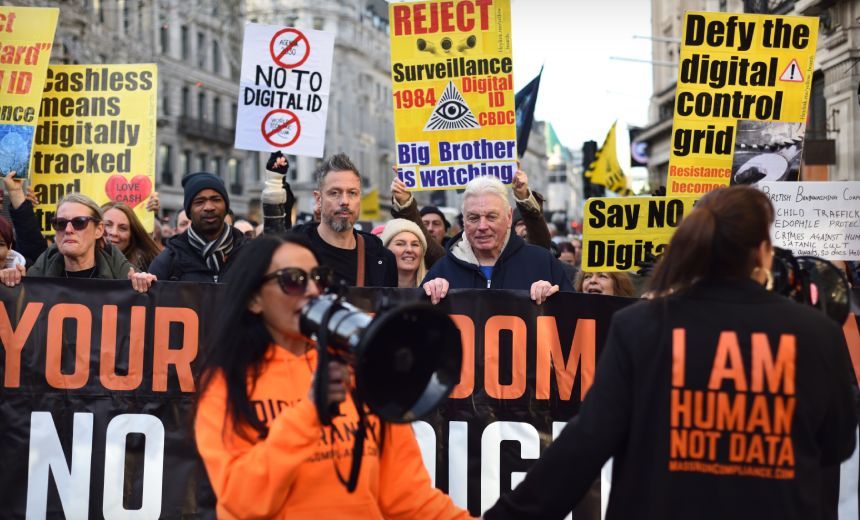
Britain’s new prime minister promised to ditch plans to roll out a government-issued digital identification card across the country.
Labour MP Andy Burnham, who on Monday became the country’s seventh prime minister since 2016, announced that money earmarked for the digital ID program will be diverted elsewhere.
“Time and resource that was going to be spent on a national ID scheme will go instead to where it’s most needed, such as helping with the cost of living,” a spokesperson for Burham, until recently the mayor of Greater Manchester, told the BBC.
Residents of Britain continue to report seeing a strong rise in those costs, driven predominantly by an increase in food and energy prices.
“I can do something to give people some breathing space now, some help with the cost of living. And I will set out some of those measures starting tomorrow, including how we pay for them,” Burnham said in his first speech Monday as prime minister, following King Charles III inviting him to form a government.
The independent, non-partisan U.K. think tank Institute for Government called Burnham’s move to ditch digital ID cards “unsurprising,” and no doubt informed in part by his very first role as a junior minister at the Home Office in the 2000s, when he was tasked with shepherding the rollout of a new, national ID card.
“Now he has unsurprisingly decided, having inherited plans that were rushed, confused and uncosted, to kill the plans off again. In doing so, he has added to the growing list of times that government plans for ID have foundered,” it said.
Former Prime Minister Keir Starmer in September 2025 announced the launch of a new, national ID card program, set to go live by July 2029. “Digital ID is an enormous opportunity for the U.K.,” Starmer said. “It will make it tougher to work illegally in this country, making our borders more secure. And it will also offer ordinary citizens countless benefits, like being able to prove your identity to access key services swiftly – rather than hunting around for an old utility bill.”
Ministers said the card would exist on an individual’s smartphone, in a government-built wallet and could be used to apply for benefits, driving licenses, obtain tax records and more.
Civil right groups quickly cried foul over what was being referred to as the “BritCard.” Silkie Carlo, director of Big Brother Watch, called the plans “wholly unBritish,” and warned that “incredibly sensitive information about each and every one of us would be hoarded by the state and vulnerable to cyberattacks.”
The program faced existential questions. “What is this a solution to?” asked cybersecurity expert Alan Woodward, a computer science professor at England’s University of Surrey. He also warned that centralizing so much sensitive personal information in a single location was the equivalent of saying “come and hack me.”
In November 2025, the U.K. Office for Budget Responsibility said the digital ID card implementation program was forecast to cost $2.4 billion over the next three years.
Uncertainty over the digital ID card’s purpose continued to linger. “It was initially framed as a mandatory scheme to enable right to work checks, but it was never explained why shadow economy employers would be any more diligent checking digital ID than the analogue papers they are supposed to check now,” the Institute for Government said.
Questions over its provenance also persisted, not least because the proposal never featured in the Labour Party’s Manifesto, which commits to pursuing and funding specific policy objectives.
“Unusually, this announcement followed not from a rigorous policy development and public consultation process, but instead a report from a think tank and a series of media interventions by senior politicians,” said a May parliamentary report about the “politically controversial program.”
The same month, Starmer ultimately U-turned, announcing that use of the cards would become voluntary.
At the time, Karen Bradley, chair of the Parliament’s Home Affairs Committee, said her committee still backed the “potential” for digital IDs, provided they could be salvaged.
“The government’s early attempts to set out its plans for digital ID were nothing short of a fiasco. To the public this announcement came out of the blue and made little sense,” she said. “It raised fears of government over-reach into people’s lives and was so poorly thought out that they had few answers to ease these concerns.”
Scope Creep
Britain hasn’t had a national ID card since World War II, when national security considerations trumped other concerns. But with the war over and reports of the emergency measure being used by the state for far more than its intended purpose, calls to ditch the cards intensified. In 1952, campaigning under the slogan “set the people free,” Winston Churchill abolished national ID cards, in his third tenure as prime minister.
Legislation passed by Tony Blair’s Labour government reintroduced national ID cards in 2006, backed by a new National Identity Register database. Blair’s government promised such cards would combat fraud and identity theft.
At the time, public surveys suggested mixed feelings about national ID cards. Some studies reported that people didn’t mind the concept. But trial programs, including in Manchester, showed that the vast majority of the British public didn’t want to have to carry one themselves. A campaign called NO21D launched to combat them.
The government made such ID cards mandatory for legal immigrants, replacing what had been a sticker in a passport. All permanent residents, migrant workers, foreign students and their family members needed to pay for a more expensive biometric identity card that included fingerprint data, with 200,000 of these cards being issued by 2010.
The new Conservative government abolished the national ID card law that year, by which point only 15,000 British residents had voluntarily signed up to buy one, scuttling the database. The cards continued to serve as mandatory “biometric resident permits” for non-citizens legally residing in the country, until being phased out in 2024 in favor of a “digital eVisa.”
The Tony Blair Institute, a think tank and policy consultancy, since 2023 has been sounding the drum for what it’s now touting as being a “super ID card,” saying that such “verifiable credentials,” living in a government-built wallet on people’s phones, would reduce fraud and increase public access to government services.
The institute is primarily funded by philanthropic donations, with the largest single commitment being $272 million by Larry Ellison, co-founder of database giant Oracle.